
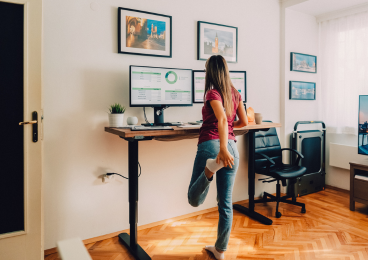
The modern office has a funny way of selling hope. It promises that if you stand instead of sitting, your body will quietly transform while you answer emails. Calories will burn. Posture will improve. Guilt will fade. The standing desk has been framed as a small rebellion against sedentary life, a polite protest you can do while still making deadlines. But behind the step counters and wellness slogans sits a stubborn question. Is standing really exercise, or is it just a better way to feel productive without actually moving much at all. The truth is more interesting than the myth, and far more useful if you actually care about your health and not just your desk setup.

Standing Burns Calories, But Let’s Not Get Carried Away
Standing does burn more calories than sitting, and that part is not a lie. The problem is scale. The human body is efficient to a fault. When you stand still, your muscles wake up just enough to keep you upright, but they are not throwing a party. Research shows that standing burns slightly more calories per hour than sitting, but the difference is closer to pocket change than a paycheck. If you stand for an entire workday, you might burn the equivalent of a small snack. Not a meal. Definitely not dessert.
This is where calorie counters quietly bend the story. Numbers look impressive when isolated. Ten extra calories here, fifteen there, multiplied across weeks and months. On paper, it feels like progress. In real life, it is modest at best. Standing is not exercise in the traditional sense. It does not raise your heart rate enough to strengthen it. It does not challenge your muscles enough to make them stronger. It does not replace walking, lifting, or intentional movement.
But calling standing useless would also be wrong. Standing changes how your body behaves during long work hours. It reduces the pressure on your lower back. It encourages small movements like shifting weight or pacing during calls. Those tiny motions matter more than calorie charts suggest. Health is not just about burning energy. It is also about reducing strain and keeping joints from locking into one position all day.
The myth is not that standing helps. The myth is that standing alone is enough. The smartest approach is not to stand all day chasing a calorie fantasy, but to use standing as a way to break the long stillness that sitting creates. That is where a well designed standing desk quietly earns its place, not as a fitness tool, but as a movement reminder built into your workday.

The Standing Desk Industry Loves Your Optimism
If you listen closely to the marketing around standing desks, you might think they are one step away from replacing gym memberships. The language is subtle but confident. Burn more calories. Boost energy. Work smarter. It sounds scientific enough to trust and vague enough to avoid promises. This is not a conspiracy. It is optimism with good lighting.
The real value of a standing desk has never been about pretending work equals exercise. It has been about control. When you can change your posture throughout the day, you stop forcing your body to adapt to furniture that does not care about you. Sitting for eight straight hours is not natural. Standing for eight straight hours is not natural either. The problem is not the position. The problem is staying there too long.
This is where many people get disappointed. They buy a standing desk expecting visible changes on the scale. Weeks later, nothing dramatic happens. The desk gets blamed. In reality, the desk did exactly what it was supposed to do. It gave you an option. What you do with that option matters more than the option itself.
A standing desk that adjusts smoothly and fits into your workflow makes it easier to alternate between sitting and standing without friction. That matters because behavior follows convenience. When switching positions feels easy, you do it more often. Over time, those shifts reduce stiffness, improve focus, and make movement feel normal again instead of forced.
This is why thoughtful designs like those from FlexiSpot tend to show up in serious home offices. Not because they promise miracles, but because they remove excuses. Quiet motors, stable frames, and simple controls make posture changes feel like part of work instead of a disruption. That is not flashy, but it is effective.
The industry did not trick us by selling desks. We tricked ourselves by expecting desks to do the work for us.

Standing Is Not Exercise, But It Is a Gateway Habit
Here is the part most headlines skip. Standing is not exercise, but it often leads to it. When you stand, your body becomes slightly more aware of itself. You notice tight hips. You notice restless feet. You notice that you want to move. Sitting dulls those signals. Standing turns the volume up just enough to hear them again.
This is why people who use standing desks often report moving more, even if unintentionally. They pace during calls. They stretch while waiting for files to load. They step away more often because it feels natural, not because a reminder popped up on their screen. None of this looks impressive on a calorie counter, but it adds up in ways that matter.
Health is built through habits that do not feel heroic. It is built through choices that repeat themselves quietly. Standing creates opportunities for micro movement, and micro movement is what keeps the body from stiffening into discomfort and fatigue. Over time, this can mean fewer aches, better focus, and a workday that does not leave you feeling like furniture at the end of it.
The smartest way to use a standing desk is not to chase numbers, but to support rhythm. Sit when you need stability. Stand when you feel restless. Move when your body asks for it. A desk that adjusts easily supports that rhythm instead of fighting it. This is where a reliable standing desk becomes less about posture and more about permission.
So no, standing is not exercise, and yes, calorie counters oversell it. But standing is not a scam either. It is a small lever that nudges behavior in a better direction. When paired with intentional movement, even short walks and light stretching, it becomes part of a system that actually works.
The myth falls apart when we stop asking standing to do everything. The benefit appears when we let it do one thing well. Help us move just enough to remember that we can.