
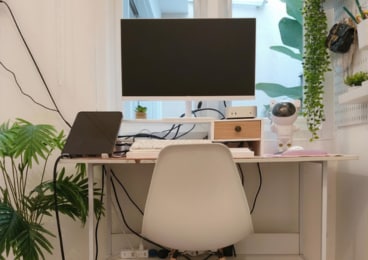
A moment comes when the desk you rely on starts to feel slightly off. Nothing dramatic, just a quiet tension that builds over time. You notice it when your eyes catch a tangle of cords before you even begin. You feel it when reaching for a charger takes more effort than it should. You hear it in the faint drag of cables shifting against the edge of your desk. That is where this shift began for me. Not with a big decision, but with small, repeated distractions that slowly wore down my focus. I began to see that my charging cords were not just part of the setup. They were shaping how I worked, how I thought, and how I moved through my day.

The Quiet Chaos Beneath the Surface
At first glance, cables seem harmless. They power our devices, connect our tools, and keep our work moving. Yet beneath that function lies a quiet kind of chaos. Charging cords rarely stay where you leave them. They twist into each other, slide off surfaces, and gather dust in corners you do not often check. Over time, they create a visual noise that your brain never fully ignores. Even when you try to focus, a part of your attention is pulled toward the disorder.
This is not just about appearance. It is about cognitive load. Studies in environmental psychology suggest that clutter competes for your attention, reducing your ability to focus and process information. A desk filled with tangled cords sends a subtle signal that things are unfinished or out of control. It becomes harder to settle into deep work when your environment feels unsettled. The mess under your desk begins to mirror the mess in your thoughts.
There is also the physical reality. Cables limit movement. They catch on chair legs, wrap around your feet, and create friction in what should be a smooth workflow. Even a small interruption, repeated many times a day, begins to wear on your energy. You adjust your posture, shift your chair, or pause to untangle something that should not need your attention at all. These moments may seem small, but they accumulate into a steady drain on your productivity.
Over time, I began to see cables not as neutral objects, but as obstacles. They were the quiet reason my desk never felt truly organized, no matter how often I cleaned it. They were the hidden layer of clutter that kept returning. And once I saw it, I could not unsee it.

Why Cables Work Against an Organized Mind
An organized person does not simply arrange things. They design systems that reduce friction. They think about flow, access, and ease. Charging cords, by their nature, resist this kind of order. They are flexible, unpredictable, and always in motion. Even when you try to group them, they find ways to overlap and tangle again. It is not a failure of discipline. It is a failure of design.
The problem lies in how cables occupy space. They do not stay in one defined area. They stretch across surfaces, hang off edges, and gather in loose bundles that shift throughout the day. This makes it difficult to maintain a clean visual field. A clutter-free workstation is not only about what you see on top of your desk. It is also about what you do not see. When cables spill into view, they break that sense of calm and order.
There is also the issue of safety. Loose cords create small but real risks. They can be pulled accidentally, causing devices to fall. They can wear down over time when bent at sharp angles. In homes with pets, they become something else entirely. A curious animal may see a cable as something to chew, turning a simple inconvenience into a serious hazard. An organized workspace should reduce risk, not introduce it.
Heat and dust add another layer to the problem. When cables are piled together without structure, they trap heat and collect dust. This can affect the performance and lifespan of your devices. It is a detail many people overlook, but it matters. A well-designed workspace considers not only how things look, but how they function over time.
What changed my perspective was realizing that the solution was not to manage cables better, but to manage them differently. Instead of trying to control something that resists control, I needed a system that gave cables a defined place to exist without interfering with my work.

Building a Desk That Works With You
The shift was simple, but it felt significant. I stopped thinking of cable management as an afterthought and started treating it as part of the desk itself. This is where the FlexiSpot Cable Management Tray CMP502 came into the picture. It did not promise anything dramatic. It simply offered structure, and that was exactly what was missing.
The idea is straightforward. Instead of letting cords spread across your workspace, you guide them into a dedicated tray mounted beneath your desk. Out of sight, but still within reach. This creates a clear boundary between what belongs on your desk and what does not. The result is immediate. The surface becomes clean. The visual noise disappears. Your attention has fewer places to wander.
What stands out about this approach is how it supports both function and comfort. The open design allows airflow, which helps prevent heat buildup and keeps dust from settling too easily. It also makes it easier to access your cables when needed. You are not locking them away. You are simply giving them a home where they can exist without causing disruption.
There is also a sense of safety that comes with it. By lifting cables off the floor and organizing them in one place, you reduce the risk of accidental pulls and damage. If you have pets, this becomes even more important. The space under your desk becomes cleaner and safer, both for you and for anything that might wander there.
Installation is another detail that matters. A system only works if it is easy to use and maintain. With a design that mounts securely using screws, the tray becomes a stable part of your setup rather than a temporary fix. It does not rely on adhesives that wear out over time. It stays where it should, doing its job quietly in the background.
What surprised me most was not just the visual improvement, but the shift in how I worked. A clutter-free workstation creates a kind of mental clarity that is hard to describe until you experience it. You sit down, and everything feels ready. There is no need to adjust or fix anything before you begin. The space supports you instead of asking for your attention.
Breaking up with my charging cords was never about removing them entirely. It was about changing the relationship. They no longer dominate the space or interrupt the flow of my day. They exist where they are needed, and nowhere else. And in that quiet change, the desk becomes what it was always meant to be. A place where work feels lighter, focus comes easier, and the small details no longer stand in your way.