
Your desk does more than hold a laptop. It shapes how you move through the workday. It decides whether your notebook has a proper home, whether your second monitor gets enough breathing room, and whether your coffee ends up beside your keyboard or dangerously close to it. A desk can make work feel calm and ordered, or make every task feel like it is competing for the same small patch of real estate.
That is why choosing between a standard standing desk and an L-shaped standing desk is not simply a question of size. It is a question of how you work.
A standard standing desk keeps things focused. An L-shaped desk gives you room to spread out. Both can support healthier sit-stand habits, better organization, and a more flexible workspace, but they suit very different rhythms.
The real question is not which desk looks better. It is which desk makes sense for the way you actually spend your day.
--altImgStart--{"link":"https://s3.springbeetle.com/prod-us2-bucket/FlexiSpotE5intheoffice_20260930_4QalghSd.png","alt":"FlexiSpot E5 in the office"}--altImgEnd--
When a Standard Standing Desk Keeps Your Workday Focused
Some workspaces benefit from a little restraint. If your daily setup revolves around a laptop, monitor, keyboard, notebook, and perhaps a few carefully chosen accessories, a standard standing desk can provide all the room you need without taking over the room itself.
The FlexiSpot Pro Standing Desk (E5) is designed around this idea of practical flexibility. Its height adjusts from 23.6 to 49.2 inches, giving users a broad range for finding a comfortable seated or standing position. That range matters because good desk height is not one-size-fits-all. Your elbows, shoulders, monitor, and feet all have a relationship with the desk, and a wider adjustment range makes it easier to find a position that feels natural.
The E5 also uses a dual-motor lifting system for smooth transitions between sitting and standing, with operating noise below 50 dB. Its T-form frame and wide base are built for stability, while the double crossbeam helps distribute force across the desktop. The frame uses steel and supports up to 220 pounds, giving the desk enough strength for a substantial everyday setup.
Then there is the smart keypad. Four memory presets allow you to save favorite heights, so changing positions takes only a touch. Anti-collision technology also stops and retracts the desk when it detects an obstacle.
These details may sound small, but small conveniences have a way of becoming important when repeated dozens of times a week. A standard desk works particularly well for people who like a clean, focused station where everything has a purpose and unnecessary movement is kept to a minimum.
It is also a sensible choice for smaller offices, bedrooms, apartments, or shared workspaces where floor space matters as much as desktop space. The desk gives you room to work without asking the entire room to rearrange itself around your furniture.
--altImgStart--{"link":"https://s3.springbeetle.com/prod-us2-bucket/FlexiSpotE1Lattheofficecorner_20260930_82e5DfdO.png","alt":"FlexiSpot E1L at the office corner"}--altImgEnd--
When Your Work Needs a Corner, an L-Shaped Desk Makes Sense
Some jobs refuse to stay in one neat rectangle. Maybe you work with two or three monitors. Maybe one side of your desk holds a computer while the other becomes a writing area. Perhaps your day moves between spreadsheets, video calls, creative projects, reference materials, and a notebook that somehow always needs to be open.
For this kind of work, an L-shaped standing desk can feel less like a bigger desk and more like a better map of your day.
The FlexiSpot L-Shaped Standing Desk (E1L) gives you a large work surface designed for multitasking. Its reversible L-shaped panel can be configured for either left- or right-handed users, making it easier to adapt the desk to the room rather than forcing the room to adapt to the desk.
The E1L uses a dual-motor lifting system with a height range of 28.9 to 48.2 inches. Like the E5, it operates at under 50 dB, keeping height adjustments relatively quiet. Three programmable memory settings let you save preferred positions for sitting and standing, which is useful when different parts of your workday call for different postures.
The desk has an industrial-grade steel frame and a solid desktop with a maximum weight capacity of 177 pounds. That gives you considerable room for monitors, computers, office equipment, and other everyday tools. Anti-collision technology automatically stops and reverses the desktop when it detects an unexpected obstacle, adding another layer of protection during adjustments.
But the biggest advantage is the shape itself.
An L-shaped surface creates natural zones. One side can become your primary computer station while the other handles paperwork, creative work, meetings, or equipment. Instead of constantly moving things around to make space, you can give different activities their own territory.
That can be especially useful for professionals who rarely do one kind of work all day. Designers, developers, content creators, analysts, streamers, and home-based business owners may appreciate having separate areas without needing a second desk.
Of course, more surface area comes with a trade-off. An L-shaped desk needs more floor space and works best when the room can accommodate its footprint. It can also encourage you to collect more things simply because there is somewhere to put them. More desk does not automatically mean better organization.
The shape works best when the extra space serves a purpose.
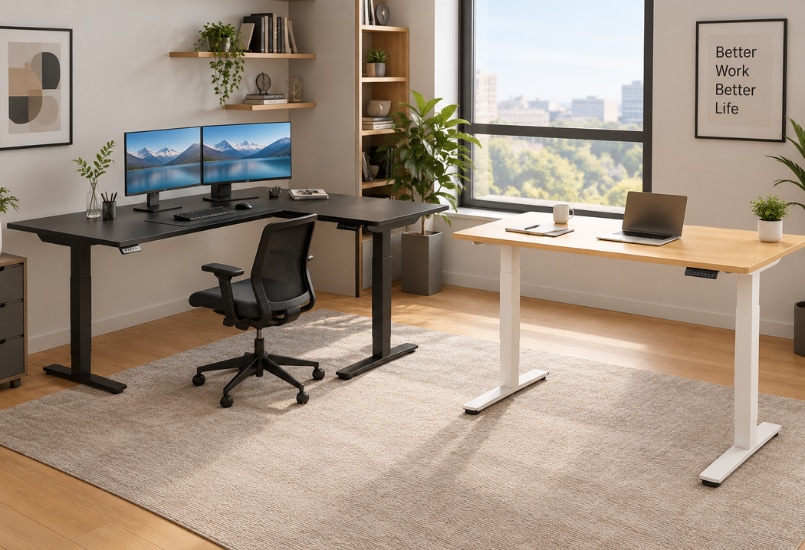
--altImgStart--{"link":"https://s3.springbeetle.com/prod-us2-bucket/FlexiSpotE1LandE5inabigofficeroom_20260930_LqCKXgzD.png","alt":"FlexiSpot E1L and E5 in a big office room"}--altImgEnd--
The Right Desk Depends on How Your Work Moves
Think about your workday as a physical routine rather than a list of tasks. Do you sit down with one computer and spend most of the day focused on a single screen? Do you move between spreadsheets, calls, notes, and creative projects? Do you need space for equipment that stays permanently on the desk? Or do you prefer a simple surface that can be cleared at the end of the day?
Your answers reveal more than the size of your room ever could.
A standard standing desk such as the FlexiSpot Pro Standing Desk (E5) is well suited to a focused setup. Its 220-pound capacity, broad height range, dual motors, four memory presets, cable management support, and sturdy steel construction make it adaptable without requiring a large footprint. It is the kind of desk that can quietly fit into different rooms and different routines.
The FlexiSpot L-Shaped Standing Desk (E1L), meanwhile, is built for work that spreads out. Its reversible panel, large L-shaped surface, 177-pound weight capacity, dual motors, three programmable presets, and sturdy steel frame make it suitable for setups where multiple activities need to happen side by side.
Neither shape solves every workspace problem. A standard desk may feel limiting if your work requires several permanent stations. An L-shaped desk may feel excessive if most of your day involves one laptop and a single monitor. The better choice comes from matching the desk to your habits, available space, equipment, and the way you naturally organize your work.
A good workspace should not constantly demand your attention. It should make the next task easier to begin.
That is perhaps the simplest way to think about the choice. If your work moves in a straight line, a standard standing desk may give you exactly the structure you need. If your work branches in several directions, an L-shaped desk can give those directions room to coexist.
The desk is only furniture. But when its shape matches your workstyle, the entire workday can feel a little more natural.