
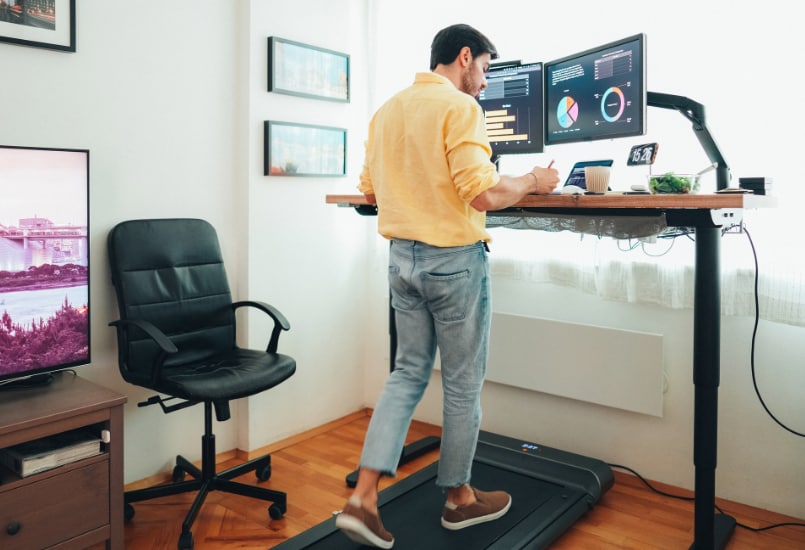
For many people, work means sitting for hours with barely a thought about how much time has passed. One email becomes ten. A meeting becomes another meeting. Lunch happens at the desk. Before long, the body feels heavy, the shoulders feel tight, and the afternoon seems to move more slowly than the morning.
Standing while working does not mean spending eight hours on your feet. It means giving your body another option.
--altImgStart--{"link":"https://s3.springbeetle.com/prod-us2-bucket/womanstandingwhileworking_20260910_r9peIe6P.png","alt":"woman standing while working"}--altImgEnd--
Standing Breaks Up the Monotony of Sitting
Sitting is comfortable, which is precisely why it is so easy to do for hours without noticing.
You sit down to write one report. You remain seated to answer messages. You stay in the chair during a video call because there is no reason to get up. Then another task appears, followed by another. Before you realize it, most of the day has passed with very little movement.
The body, however, was never designed to remain in one position indefinitely.
Standing gives you an opportunity to change that pattern. Even a short period on your feet can feel different from sitting continuously. Your weight shifts. Your legs engage. You may naturally move around more. You might walk to refill your water, stretch your shoulders, or take a few steps while thinking through a difficult problem.
This is why the idea of a standing desk should not be understood as replacing sitting with standing. It is better understood as creating another option.
Alternating between sitting and standing allows you to respond to what your body needs during different parts of the day. You might sit while handling detailed work that requires intense concentration, then stand during a phone call or while reviewing documents. You might lower your desk again when your legs need a break and raise it later when you want a change.
The simple act of changing position can also make the workday feel less repetitive. Instead of spending eight hours in the same physical arrangement, you create natural transitions between tasks.
Those transitions matter. They can become small moments when you check your posture, take a breath, look away from your screen, or move your body.
Standing should not be treated as a punishment for sitting. It is simply another tool for creating a more active work routine.
And sometimes, the smallest change is enough to make a long afternoon feel noticeably different.
--altImgStart--{"link":"https://s3.springbeetle.com/prod-us2-bucket/mansmilingwhilestandingatwork_20260910_DlrBBjcK.png","alt":"man smiling while standing at work"}--altImgEnd--
Your Energy, Focus, and Mood Can Benefit From More Movement
The afternoon slump has become almost a cultural tradition.
You know the feeling. The morning was productive, but somewhere after lunch, your concentration begins to wander. You reread the same sentence. You stare at an unfinished spreadsheet. You open your inbox and somehow end up looking at the same three messages again.
It is tempting to reach for another cup of coffee.
Sometimes, what you really need is movement.
Physical activity and work performance are closely connected. Moving throughout the day supports overall health and can help you feel more alert than remaining completely still for long periods. A standing work position can be one simple way to introduce more movement into an otherwise sedentary routine.
It can also create useful psychological breaks.
When you stand during a meeting, for example, the change in posture can make the meeting feel different from the one before it. When you stand while making a phone call, you may naturally pace around the room. When you rise to think through a problem, you create a physical pause that can help separate one task from another.
These moments do not have to last long.
Imagine working for a while and then standing for ten or fifteen minutes before sitting again. Later, you take a short walk to get water. After another stretch of computer work, you stand again. None of these actions needs to interrupt your entire schedule.
In fact, they can become part of it.
The important thing is to avoid thinking of standing as a productivity trick that must be performed perfectly. You do not need to stand through every email or spend an entire morning on your feet. Comfort matters. Good posture matters. Movement matters most.
Your body also gives you useful signals. If your feet become tired, sit down. If your shoulders feel tense, adjust your setup. If you have been sitting for too long, get up. A good workspace should make these choices easy rather than forcing you into one position.
This is where a more flexible approach to work becomes valuable. Instead of asking, “Should I sit or stand today?” ask, “What position makes sense for what I am doing right now?”
That small shift in thinking can turn movement from something you remember occasionally into something naturally woven into your workday.
--altImgStart--{"link":"https://s3.springbeetle.com/prod-us2-bucket/topshotofFlexiSpotQ8_20260910_UiuDccKB.png","alt":"top shot of FlexiSpot Q8"}--altImgEnd--
Choose a Workspace That Makes Movement Easy
A standing routine is only practical when your workspace can support it.
A desk that is too low can force you to hunch when standing. One that is too high can make your shoulders uncomfortable. If your monitor, keyboard, mouse, and other equipment remain positioned for sitting, simply standing up may create a new set of problems.
This is why an adjustable desk can be a worthwhile addition to a home office or professional workspace.
A height-adjustable desk allows you to change the working surface to suit your position instead of asking your body to adapt to a fixed height. That flexibility can make it easier to alternate between sitting and standing while keeping your equipment at a comfortable working level.
One option worth considering is the FlexiSpot Comhar Pro Standing Desk (Q8). Its three-stage frame offers a height range from 24.0 to 49.2 inches, giving users plenty of room to find a comfortable sitting or standing position. It also has programmable height presets, which can make switching between preferred positions quick and convenient.
The Q8 is particularly useful for people who want their desk to accommodate more than just a computer. Its 55-by-28-inch desktop provides ample space for monitors, a laptop, notebooks, and other accessories. It also includes an integrated drawer, cable management tray, wireless charging, and USB charging ports, helping keep everyday essentials organized.
Its bamboo desktop adds a natural touch to the workspace, while the dual-motor lifting system and enhanced frame are designed to provide stability as the desk moves between heights. An anti-collision function provides additional protection when the desk is being lowered.
But the desk itself is only part of the solution.
Your monitor should be positioned so you can look toward the screen without constantly bending your neck. Your keyboard and mouse should allow your arms to remain relaxed. Your feet should have a comfortable place to rest when sitting. When standing, your weight should feel balanced rather than concentrated awkwardly on one side.
Most importantly, give yourself permission to move.
Stand during a short meeting. Sit when you need to concentrate. Walk while thinking. Stretch between tasks. Change your position when you feel uncomfortable instead of waiting for discomfort to become impossible to ignore.
A productive workspace does not need to keep you perfectly still.
It should make movement easy.
That may be the most important lesson behind the standing-desk trend. Standing is not about proving that you can work on your feet for hours. It is about breaking the expectation that work must happen in one position from morning until evening.
Your best work can happen while sitting. It can happen while standing. It can happen after a short walk when an idea suddenly comes together.
The modern workday already asks a lot from your mind. Your workspace should not make unnecessary demands on your body, too.
Sometimes, improving the way you work does not require a dramatic overhaul. It starts with raising the desk, straightening your posture, taking a breath, and giving yourself permission to stand.
Then, when you are ready, you sit back down and keep going.