
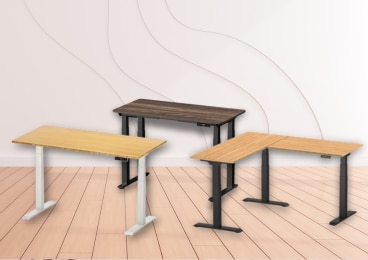
Standing desks have quietly become the status symbol of modern work. They signal intention. They suggest that you care about your body, your focus, and the long hours spent in front of a screen. But choosing the right standing desk is not about copying a setup you saw online or buying the largest frame your room can hold. It is about understanding how you actually work, how much space you truly need, and how steady your desk must be when your workload gets serious. The move from a simple laptop setup to a multi-monitor workstation is not just about adding more screens. It is about building a foundation that supports longer days, heavier equipment, and sharper concentration. A good standing desk does more than lift up and down. It keeps you balanced, comfortable, and focused, even when the workday feels full and demanding.

The Two-Leg Desk Is Not Basic, You Just Never Used It Properly
The two-leg standing desk is often dismissed as the starter option, which is unfair and a little lazy. For laptop users, writers, designers, and professionals who rely on one or two monitors, a well built two-leg desk can be more than enough. The real issue is not the number of legs. It is the quality of the frame, the strength of the motors, and how well the desk holds its ground when you raise it to full height.
A strong two-leg standing desk offers clean lines, a smaller footprint, and flexibility in rooms where space matters. When designed correctly, it does not shake, drift, or complain when you load it with equipment. The FlexiSpot Pro Plus Standing Desk E7 is a good example of why the stereotype does not hold up. Its solid carbon steel base and thicker leg columns keep the desk steady at every height, even when the surface carries heavy monitors and accessories. Flexible does not mean flimsy, and the E7 proves that stability can come in a simpler form.
For many professionals, this type of desk supports growth rather than limiting it. You can start with a laptop and one monitor and expand without replacing the entire setup. The high weight capacity means the desk is not living on borrowed time. Smooth height transitions matter too, especially when you move between sitting and standing multiple times a day. The E7 moves quietly and evenly, which keeps your focus intact and your coffee where it belongs.
A two-leg desk is ideal if your work values clarity, order, and adaptability. It fits writers who shift between deep thinking and fast typing, remote workers who need reliable performance, and anyone who wants a standing desk that works hard without asking for attention.

Four Legs Are Not Excessive If Your Desk Carries Your Whole Career
There comes a point when your desk stops being a surface and starts being a structure. If you work with three monitors, heavy mounts, audio equipment, or creative tools that turn your workspace into a command center, stability becomes non-negotiable. This is where the four-leg standing desk earns its reputation.
A four-leg frame distributes weight evenly, which dramatically reduces wobble at standing height. The FlexiSpot 4-Leg Standing Desk E7 Plus shows what happens when stability is treated as a priority rather than a bonus. In testing, the desk remains steady even when raised fully, with no visible vibration. This matters more than people admit. A desk that shakes breaks focus, strains your wrists, and slowly turns standing into something you avoid.
Beyond stability, a four-leg desk supports complexity. The E7 Plus works well with monitor mounts, under desk drawers, and keyboard trays because the frame is designed to leave space where you actually need it. This makes it suitable for professionals who juggle multiple tasks at once, such as analysts, editors, developers, and studio creators.
The extended height range also makes it practical for shared spaces or home offices used by more than one person. Preset controls let users move between heights quickly, which sounds small until you experience it daily. The four-leg design is not about being flashy. It is about reliability when your desk holds your tools, your workflow, and your patience.
If your desk feels like it carries your entire workday and sometimes your stress along with it, four-legs may be exactly what you need.

L-Shaped Desks Are Not About Space, They Are About Control
The L-shaped standing desk is often chosen for size, but its real strength lies in control. It allows you to separate tasks physically, which can be surprisingly effective for focus. One side can hold monitors and main work, while the other supports writing, sketching, planning, or gaming after hours. This layout mirrors how many people think, moving between zones rather than staying fixed in one spot.
The FlexiSpot Pro L Shaped Standing Desk E7L is built for users who manage multiple streams of work at once. Its three leg design adds stability beyond a standard two-leg desk, while still fitting into corners efficiently. The wide surface supports multiple monitors, equipment, and documents without feeling crowded. The reversible panel makes it practical for both left handed and right handed users, which is a detail many desks overlook.
The E7L also handles weight confidently, allowing users to load the surface without second guessing every addition. Smooth height adjustment keeps transitions easy, even with a full setup. For professionals who work long hours or switch between roles throughout the day, this desk adapts instead of forcing compromise.
An L-shaped desk suits power users, gamers, creatives, and anyone whose work spills across more than one mental space. It is not about having more desks. It is about giving each task a place to live.
Choosing a standing desk is not about chasing trends. It is about understanding how you work today and where your setup is headed tomorrow. Whether you are starting with a laptop or already managing a wall of screens, the right desk supports your work quietly and steadily, which is exactly how it should be.