
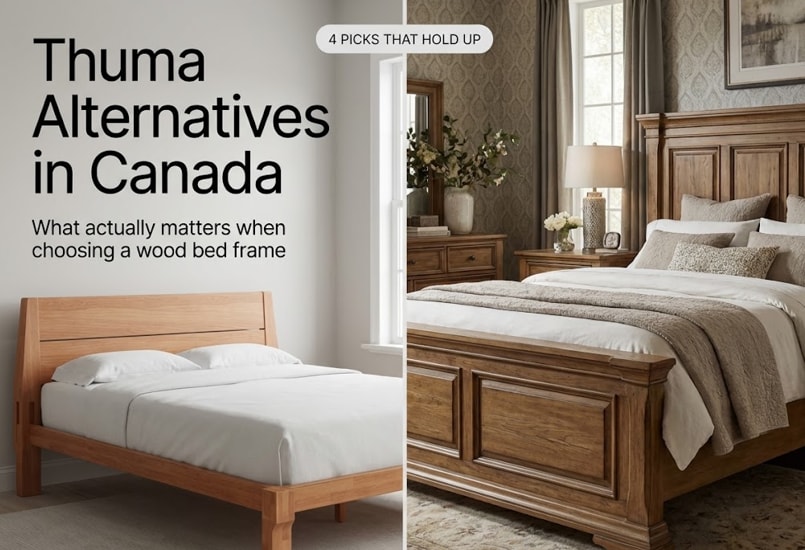
If you've tried buying a Thuma bed frame from Canada, you've probably run into the same issues. Limited availability. Cross-border shipping. And a final price that's higher than expected once duties are added.
So people start looking for something similar. Not identical. Just something that gets the same basics right. Clean design. Real wood. A structure that stays quiet. Something that doesn't feel disposable after two years.
_20260414_kVUrmGxr.png "download (3).png")
Before getting into alternatives, it helps to look at what people are actually reacting to.
What People Actually Like About Thuma (And What They Don't Say Out Loud)
Most descriptions of Thuma stop at "minimal" and "well-built." That's not wrong, just incomplete.
What actually stands out is a mix of things:
• Joinery-based construction (fewer screws, less long-term loosening)
• Solid wood feel (not hollow, not veneered panels)
• Low profile proportions that visually calm a room
• Quick assembly without tools
That said, there are trade-offs people don't always mention:
• Price climbs quickly outside the U.S.
• Limited wood tone options
• Availability isn't consistent in Canada
• The "one look fits all" design doesn't suit every space
So the goal isn't to mirror Thuma one to one. It's to find a wood bed frame that delivers a similar experience without those constraints.
What to Look for in a High-Quality Wood Bed Frame
A few signals are enough. When you're searching for a hardwood bed frame, here's what tends to matter.
1. Real Material, Not Just the Look
A hardwood bed frame tends to hold up better over time, especially under daily use. Softwoods can work, but they're more prone to dents and subtle flex over time.
You'll see brands mention solid wood construction or natural wood materials. That helps. But what matters more is how much of the structure actually uses it, not just the outer layer.
2. Joinery vs. Hardware
Metal fasteners aren't bad, but over time, they loosen.
Joinery systems, especially Japanese-inspired ones, tend to stay quieter. Less movement usually means less noise, especially a few months in.
3. Slat Support
Wide spacing between slats can shorten mattress lifespan. Closer spacing distributes weight more evenly and reduces sagging.
It's the kind of detail you don't notice at first, but it shows up later.
4. Height and Proportion
Low-profile frames look better in photos, but they're not always practical. If you're used to a higher bed, going too low can feel off at first.
Best Thuma Alternatives in Canada (That Are Actually Worth Considering)
Just the ones that come up repeatedly for the right reasons.
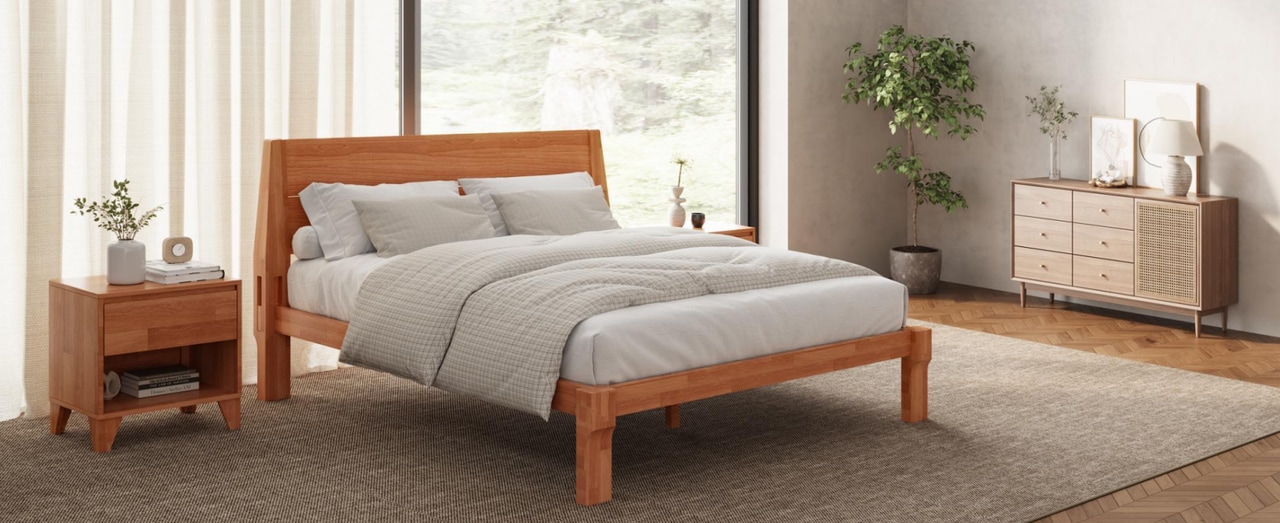
1. FlexiSpot Kana: Clean, Stable, and Easier to Live With
Kana sits in a similar design space as Thuma, but feels a bit more relaxed in how it's executed.
What stands out:
• Tool-free assembly that actually feels stable
• Clean lines without looking overly engineered
• A height that works for most setups, not overly low
• Uses natural wood materials in a way that feels straightforward
If you're comparing a few frames, this is usually where the difference shows up.
Not in photos, but while you're putting it together. Whether it shifts. Whether you need to go back and re-tighten anything. Or whether it just locks in and stays put.
That part tends to matter more than expected.
For Canadian buyers, it's also one of the easier options to get without dealing with cross-border shipping. The queen size with headboard comes in around $719.99 CAD, often a bit lower depending on current promotions (check the site for current pricing).
If you're curious how it actually comes together, you can take a closer look here.
2. Silk & Snow Wooden Bed Frame: Straightforward and Local
A Canadian brand, which already removes part of the friction.
This one is built with a considered approach:
• Uses joinery-based construction rather than relying heavily on hardware
• Clean, minimal design with optional upholstered headboard
• Feels more like a long-term furniture piece than a casual upgrade
That said, it also comes at a noticeably higher price point compared to most alternatives in this category. The queen size with headboard is typically priced at $1,525.75 CAD or higher, which puts it on the higher end for this category.
3. Article Tessu Bed: Built for Looks First
Article leans heavily into aesthetics. The Tessu bed looks great in photos. Wide frame, low stance, strong presence in a room.
From a build standpoint, it's a different approach:
• More hardware-reliant
• Feels more like a design piece than something built for repeated assembly or movement
• More about how it looks in a room than how it holds up over time
For a queen size with headboard, it usually sits around the $1,199 CAD mark.
4. EQ3 Marcel Bed: Heavier, More Traditional
EQ3 is another Canadian option that comes up often.
The Marcel bed leans more traditional:
• Solid wood construction with a heavier feel
• Standard assembly
• Slightly taller, more upright proportions
It leans less minimal. Feels more grounded overall. The queen size with headboard tends to run closer to $1,749 CAD, reflecting its more substantial build and positioning.
So, What's Actually the Best Choice?
It depends on what you're trying to replicate.
If what you liked about Thuma was:
• The quiet, stable feel
• The simplicity of assembly
• The way it doesn't visually dominate the room
Then you're probably looking for a hardwood bed frame that gets the structure right first.
That's usually where the real differences show up. Not in how it looks on day one, but in how it holds together a few months in.
A Quick Way to Narrow It Down
Most people don't compare five options for long. They usually land on two.
• One that looks right
• One that feels right structurally
If those happen to be the same frame, the decision tends to make itself.
Frequently Asked Questions
1. Why is it difficult to get a Thuma bed frame in Canada?
Thuma primarily operates out of the U.S., which means higher shipping costs, inconsistent availability, and unexpected customs duties for Canadian buyers. Choosing a locally available alternative avoids those cross‑border headaches.
2. Which Thuma alternative has tool‑free assembly?
The FlexiSpot Kana is designed for tool‑free assembly. Its interlocking joints lock in place by hand, so you can set it up in minutes without screwdrivers or wrenches.
3. Does Japanese joinery prevent bed squeaking?
Yes. Unlike frames that rely on metal bolts which loosen over time, joinery‑based construction uses wood‑on‑wood connections. This reduces friction and movement, which are the primary causes of bed squeaks.
4. How do wood bed frame prices compare in Canada?
Mid‑range solid wood frames like the FlexiSpot Kana typically start around CAD 700. Premium options like the EQ3 Marcel or Silk & Snow can range from CAD 1,500 to $1,800, depending on wood species and manufacturing location.
5. Is solid wood better than wood veneer for a bed frame?
Solid wood is more durable. It can be sanded and refinished, holds joinery more securely, and won't peel or chip over years of use. Veneers offer a similar look initially but don't last as long.
6. Do these Thuma alternatives require a box spring?
No. All four alternatives use supportive slat systems designed to support a mattress directly. This improves airflow and maintains the low‑profile, minimalist aesthetic.
Final Thoughts
Here's a quick test for any bed frame. Set it up. Use it for a week. Then see if you've thought about it at all.
If you haven't, you picked well.
If you have, you already know what to look for next time.