
Most standing desk buying guides focus on lifting capacity, desktop size, and motor performance.
While those features are important, they often overlook a simple reality: not every desk is designed to fit every body.
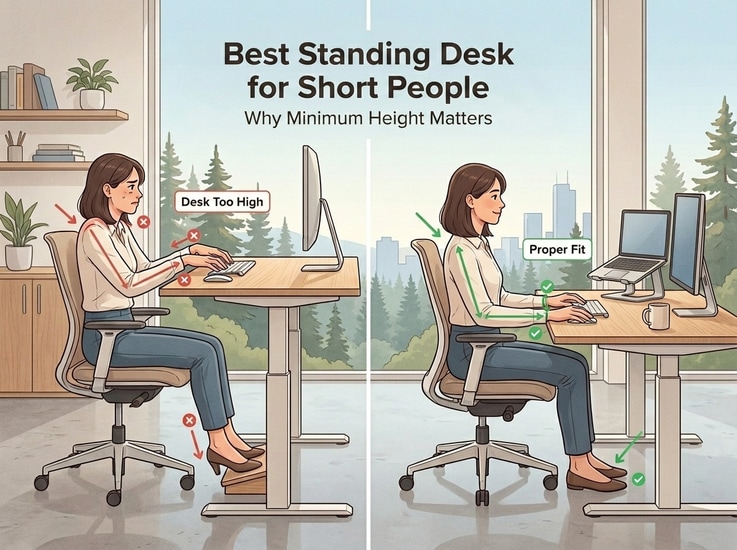
If you are 5'6" (167 cm) or under, your biggest challenge may not be finding a desk that goes high enough for standing. It may be finding one that goes low enough for sitting.
For shorter Canadians, minimum desk height can have a greater impact on long-term comfort than weight capacity, desktop material, or even motor speed. Yet it remains one of the most overlooked specifications when shopping for a standing desk.
For taller users, a desk that does not go high enough is usually easy to identify during the buying process.
For shorter users, the problem is often less obvious. Many people do not realize a desk is too high until they begin using it every day.
The Hidden Setup Trap for Shorter Users
Many standing desks sold in North America are designed around average user measurements.
That approach works reasonably well for people in the middle of the height spectrum. However, shorter users often discover a problem after the desk arrives: even at its lowest setting, the desk still feels too high.
When this happens, people often compensate by raising their chair.
While that may seem like a simple fix, it can create several new ergonomic issues:
- Feet no longer rest comfortably on the floor
- Pressure increases underneath the thighs
- Shoulders gradually elevate while typing
- Wrists bend upward during keyboard use
- Neck and upper-back tension become more common
The desk technically works, but it does not truly fit the user.
This is one reason why some shorter individuals continue experiencing discomfort even after investing in a better home office setup.
Why Shorter Users Have Different Desk Height Requirements
A common misconception is that standing desks work the same way for everyone.
In reality, ideal desk height varies significantly based on body size and proportions. A desk that feels perfectly comfortable for someone who is 5'10" may never reach an appropriate seated height for someone who is 5'1".
The table below provides general height ranges that can serve as a starting point.
| User Height | Typical Seated Desk Height | Recommended Standing Height |
| 5'0"–5'2" | 22–24 inches | 34–38 inches |
| 5'3"–5'5" | 24–26 inches | 36–40 inches |
| 5'6"–5'8" | 26–28 inches | 38–42 inches |
These values represent general ergonomic ranges rather than exact prescriptions.
Factors such as arm length, torso-to-leg proportions, footwear, keyboard thickness, and chair height can all influence the ideal adjustment.
WorkSafeNB, the occupational health and safety authority for New Brunswick, recommends a standing desk height of approximately 39 inches for a user around 5'4". However, that same user may require a seated desk height well below 28 inches to maintain neutral arm and shoulder positioning.
The key takeaway is simple: shorter users often require a wider usable height range than many buyers realize.
What Makes a Standing Desk Better for Shorter Users?
Not all height-adjustable desks offer the same adjustment range. While many buyers focus on lifting capacity or desktop size, shorter users often benefit more from features that improve ergonomic flexibility.
--altImgStart--{"link":"https://s3.springbeetle.top/prod-common-bucket/commodity/item/1028_file_standing-desk-features-for-short-users-canada_20260617_8y9FRdsp.png","alt":"Key standing desk features for shorter users including low minimum height, wide adjustment range, stability, and memory presets."}--altImgEnd--
A Lower Minimum Height
A lower starting height allows users to maintain a more natural seated posture without excessively raising their chair. This can help keep feet supported, shoulders relaxed, and wrists in a more neutral position.
A Wider Adjustment Range
Workspaces often change over time. A broader adjustment range can accommodate different sitting positions, standing positions, and even multiple users within the same household.
Consistent Stability
A standing desk should remain stable throughout its height range. Whether you are typing, writing, or using multiple monitors, stability contributes to a more comfortable experience.
Easy Height Adjustments
One of the biggest advantages of a standing desk is convenience. Preset controls and smooth adjustments make it easier to alternate between sitting and standing throughout the workday.
Why This Matters for Canadian Home Offices
Many Canadians work from home in spaces that serve multiple purposes.
A dining room may double as an office. A spare bedroom may become a workstation. In some households, the same desk is shared by multiple family members throughout the day.
This creates a unique challenge.
A desk that only works well for one height may become frustrating when used by someone significantly shorter or taller.
For households with multiple users, a wider adjustment range often provides more long-term flexibility than focusing solely on lifting capacity or desktop size.
An Example of a Desk With a Wider Adjustment Range
Some standing desks available in Canada use three-stage lifting columns and dual-motor systems to achieve a broader adjustment range.
For many users under 5'6", this type of design can provide greater flexibility when dialing in a comfortable seated working height.
A broader adjustment range can also make a desk more adaptable to shared workspaces and changing needs over time.
Stability becomes increasingly important as desks move through different height positions, especially when supporting multiple monitors or heavier desktop equipment.
One example is the FlexiSpot E7, which uses a three-stage frame and dual-motor lifting system to provide a wider height range than many traditional standing desk frames.
The E7 typically offers a height adjustment range of about 22.8" to 48.4" (58–123 cm), making it suitable for a wide range of users. For most shorter users around 5'0"–5'5", the lower minimum height helps maintain proper seated posture without raising the chair excessively, while taller users up to around 6'3" can still achieve a comfortable standing height. --altImgStart--{"link":"https://s3.springbeetle.top/prod-common-bucket/commodity/item/1028_file_standing-desk-minimum-height-for-short-people-canada_20260617_hJWCbgQn.png","alt":"Standing desk height range from 22.8 to 48.4 inches, showing how a low minimum desk height can better accommodate shorter users."}--altImgEnd--
Rather than focusing solely on maximum height, desks in this category aim to accommodate a broader range of users, including those who need lower seated positions.
Standing Desk Height Guide for Shorter Users
The table below provides a general reference for seated desk height.
| User Height | Typical Seated Desk Height |
| 5'0"–5'2" | 22–24 inches |
| 5'3"–5'5" | 24–26 inches |
| 5'6"–5'8" | 26–28 inches |
These measurements are guidelines rather than rules.
Research from Colorado State University's Ergonomics Program notes that fixed workstations built around the traditional 29–31 inch desk height are too high for a large percentage of seated users.
When possible, adjust your desk so your elbows remain close to a 90-degree angle while your shoulders stay relaxed.
A Standing Desk Alone May Not Solve Everything
Even the best standing desk cannot compensate for an incomplete workstation.
Shorter users often benefit from pairing their desk with:
- An adjustable ergonomic chair
- A monitor arm
- A footrest when needed
- An external keyboard and mouse for laptop users
These accessories can help fine-tune a workspace and improve overall comfort.
In many cases, workstation ergonomics are determined by how all of these components work together rather than by the desk alone. --altImgStart--{"link":"https://s3.springbeetle.top/prod-common-bucket/commodity/item/1028_file_ergonomic-workstation-for-short-users_20260617_2GkOUXCR.png","alt":"Ergonomic workstation setup for shorter users with adjustable chair, monitor arm, keyboard, and standing desk."}--altImgEnd--
Frequently Asked Questions
1. What is the best standing desk height for someone under 5'4"?
For seated work, many users under 5'4" require a desk height between 22 and 24 inches. The exact height depends on body proportions, chair height, and personal preference.
2. Can a standing desk be too low?
Yes. A desk that is too low may cause you to lean forward or round your shoulders. Proper desk height should allow your forearms to remain roughly parallel to the floor.
3. Are all electric standing desks suitable for short people?
No. Some standing desks have minimum heights that remain too high for shorter users. Models with broader adjustment ranges often provide greater flexibility.
4. Do I need a footrest with a standing desk?
A footrest can be helpful if your desk does not lower enough to support a comfortable seated posture. However, choosing a desk with an appropriate minimum height is often the better long-term solution.
5. How long should I stand at a standing desk each day?
Most ergonomic experts recommend alternating between sitting and standing rather than remaining in either position for extended periods. Many users find that changing positions every 30 to 60 minutes works well.
6. What should I look for when buying a standing desk?
For shorter users, key considerations include minimum height, adjustment range, stability, and ease of adjustment. These factors often have a greater impact on daily comfort than lifting capacity alone.
Final Thoughts
Most standing desk buyers spend their time comparing lifting capacity, desktop materials, and motor specifications. For shorter Canadians, however, the most important specification may be the one hidden near the bottom of the product page.
Minimum height often determines whether a desk truly fits your body.
Before choosing your next standing desk, look beyond the marketing headlines and evaluate the desk's full adjustment range. A desk that fits your height today is more likely to remain comfortable for years to come.
For shorter users, that often makes the difference between a workstation that merely functions and one that genuinely supports healthy posture every day.
References
- WorkSafeNB. Ergonomic Tips: Desk Height Recommendations. New Brunswick Occupational Health and Safety Authority.
- Colorado State University. Height Adjustable Workstations/Tables. Risk Management & Insurance Ergonomics Program.
- James Cook University. Standing Workstation Setup Guideline (2024). Workplace Health and Safety.